5 Prompt Tricks to Unlock High-Conversion Email Topic Lines
Adapting to Search Patterns in 2026
The search environment in 2026 looks nothing like the keyword-stuffed lists of a couple of years back. Users now connect with online search engine as if they are speaking with a person, asking intricate concerns that require nuanced responses. For companies attempting to stay up to date with this shift, the old method of writing one post at a time has actually ended up being a traffic jam. This is where programmatic approaches integrated with big language models have changed the method sites grow. Rather of manual entry, systems now pull from huge datasets to build thousands of pages that respond to specific user requirements without losing the quality of a hand-written article.The shift towards Asia Virtual Solutions Trends illustrates how data-heavy markets are adapting. By utilizing AI to translate structured information, a site can generate pages that feel tailor-made for each possible query. If an individual searches for the very best methods to manage a specific company task in 2026, they no longer desire a generic top-ten list. They want a guide that understands their industry, their area, and their specific restrictions. Programmatic SEO makes this possible by scaling the production of these narrow, extremely useful pages.
Scaling Material for modern business needs in 2026
Performance in material production depends upon how well a system handles data. In the past, programmatic SEO typically resulted in thin material-- pages that looked practically similar other than for an altered city name or item function. In 2026, search algorithms easily spot that kind of repetition and disregard it. Modern systems use big language models to make sure that every page has special "information gain." This implies the AI adds brand-new value to the page, maybe by connecting a regional information point to a more comprehensive market pattern or by supplying a special analysis of a particular service.Businesses that count on digital solutions have discovered that the volume of material no longer matters as much as the importance. An LLM can take a database of regional business policies and turn it into 5 hundred distinct pages, each explaining how those policies affect a various type of expert. This level of uniqueness was too pricey to produce manually. Now, it is the requirement for anyone wanting to take control of the search results page for a specific niche.
Data Management for specialized sectors
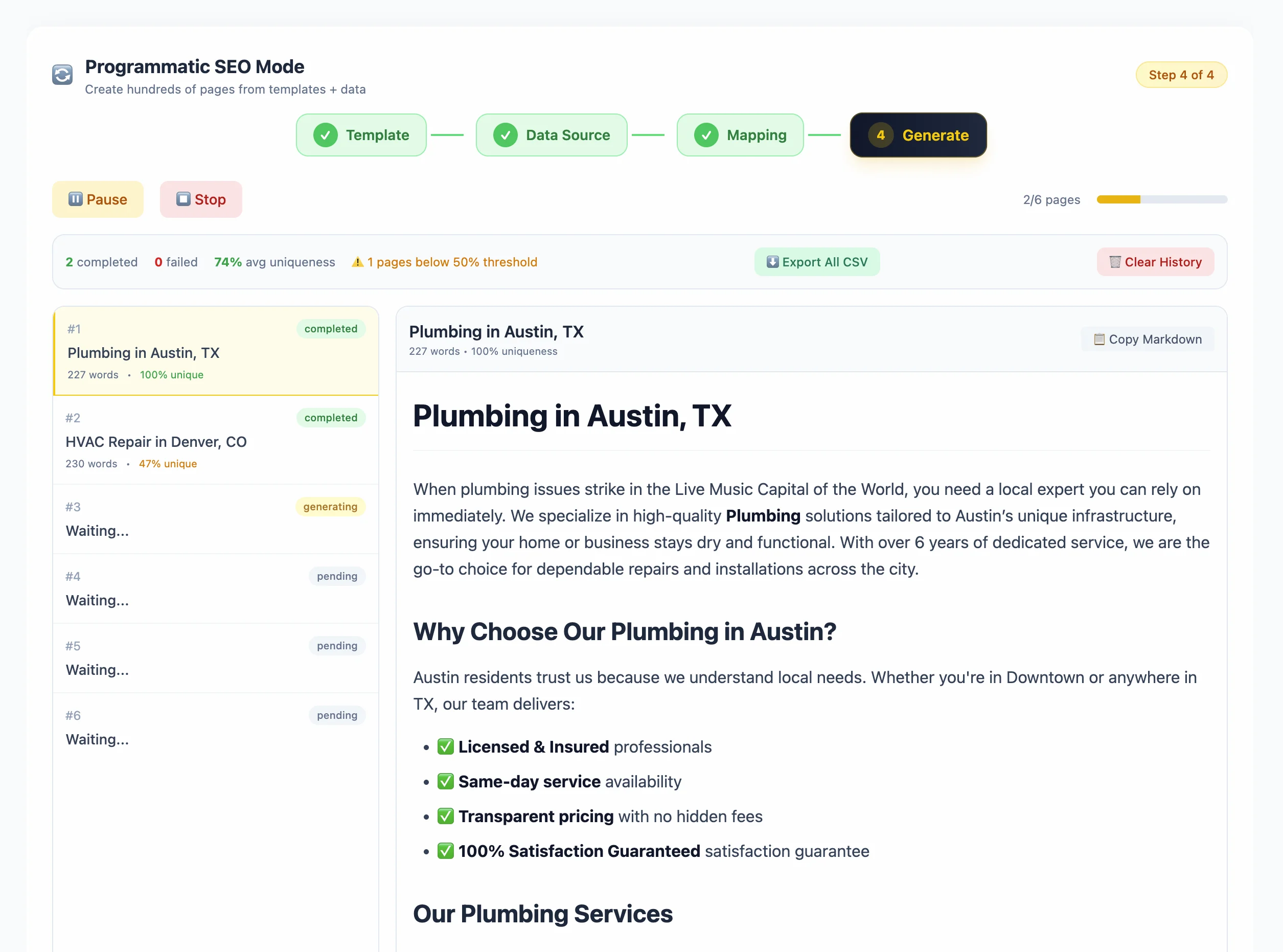
The foundation of any effective programmatic task is the information source. Whether it is a public federal government database, a private collection of consumer evaluations, or an exclusive set of industry stats, the data must be tidy. In 2026, the finest entertainers in local markets are those who treat their data like a possession. They do not simply scrape the web; they curate information that others do not have.When this information is fed into an LLM, the prompt engineering side of the procedure ends up being the concern. It is not sufficient to tell the AI to write a page. The guidelines need to consist of the particular tone, the required headers, and the information points that must be included. This avoids the design from drifting into generic territory. It makes sure that a page about services in a particular location in fact points out facts appropriate to that area, rather than just duplicating the exact same boilerplate text used for every other city.
Maintaining Quality in search optimization
One of the most significant hurdles in 2026 is the risk of AI-generated "slop." This describes content that sounds professional but states absolutely nothing of compound. To prevent this, successful operations execute a multi-stage evaluation process. The information is verified. Second, the AI generates the draft. Third, a smaller, much faster model checks the draft against the original data to guarantee facts were not developed. This "hallucination check" is what separates the marketplace leaders from the sites that get struck by search engine updates.The growing demand for Asia Virtual Solutions Digital Marketing Trends shows that quality matters more than quantity. People can tell when a page was constructed with care, even if it was technically generated by a machine. By focusing on the user experience-- making certain the text is legible, the guidance is useful, and the layout is handy-- companies can use AI to develop massive sites that individuals actually delight in using. This technique moves away from the idea of "deceiving" online search engine and focuses on supplying the very best possible answer for every long-tail question.
User Intent and local search trends
Browse engines have actually approached a model that focuses on "generative responses." When someone look for a service in 2026, they often see an AI-generated summary at the top of the page. To appear in these summaries, a site needs to be the main source of fact for its subject. Programmatic SEO enables a brand name to end up being that source by covering every possible angle of a subject across thousands of pages.If a site supplies the most in-depth information on regional industry trends,. the online search engine is more most likely to cite that website in its AI summary. This produces a cycle where the programmatic pages feed the search engine's own AI, which in turn sends more traffic back to the site. It is a cooperative relationship that rewards those who supply premium, structured details at scale.
The Technical Side of site architecture
The stack used for programmatic SEO has actually altered significantly. In 2026, developers use "vector databases" to store details in a manner that AI designs can understand quickly. Rather of simply looking for words, the system tries to find meanings. This enables the programmatic engine to pull the most relevant truths for a particular page without requiring a perfect match in the database.For example, if a page is being built for a client in an emerging market,. the system can find comparable data points from other regions and adapt them if local information is missing. This type of semantic versatility was impossible with the old template-based systems. It enables a more natural circulation of details, making the created pages a lot more resistant to changes in how search engines rank content.
Refining Output for target areas
A common error is forgetting that various areas have different ways of speaking. In 2026, LLMs are excellent at localizing content if they are offered the ideal guidelines. A page targeting a specific area must show the regional dialect and issues. This does not mean simply switching out a city name; it suggests adjusting the examples, the currency, the measurements, and even the cultural references.By setting up a programmatic pipeline that consists of a localization layer, an organization can appear like a local authority in hundreds of various local communities at the same time. This develops trust with the user. A person is more most likely to remain on a page if it feels like it was written by someone who understands their specific part of the country. This trust is the essential to transforming a searcher into a client.
Future-Proofing Your Presence in digital marketing
The fast rate of AI advancement suggests that what works in the early months of 2026 might require adjustment by the end of the year. Effective companies remain ahead by continuously checking their output. They utilize A/B screening on an enormous scale, trying different timely designs on groups of pages to see which ones carry out better in search engine result. This data-driven approach to content production turns SEO into a science instead of a thinking game.One major pattern is the combination of real-time information. In 2026, a few of the most successful programmatic websites are those that upgrade their pages immediately when new details becomes readily available. If a cost changes, a guideline is updated, or a new competitor gets in the marketplace, the AI can rewrite the relevant sections of the website immediately. This keeps the content fresh, which is a significant ranking factor for modern-day online search engine.
Competitive Advantages in web development
The barrier to entry for programmatic SEO has decreased, however the ceiling for quality has actually risen. Practically anybody can utilize a standard LLM to create a few hundred pages. Doing this at a scale of 10s of thousands of pages while preserving a high requirement of precision is still a substantial challenge. This is where specific competence becomes a competitive advantage. Those who understand how to chain different AI models together-- utilizing one for research study, one for composing, and one for editing-- produce far better results than those who use a single prompt.In 2026, the winner in any offered specific niche is normally the one who has the most extensive "moat" of exclusive information. If you know that the AI can not find in other places, your programmatic pages will constantly be better than those of your rivals. This makes data collection and organization just as essential as the AI itself. By concentrating on unique insights and clear discussion, services can dominate their particular markets.The objective is no longer simply to be discovered, but to be the most useful resource offered. Programmatic SEO with big language designs is the only method to attain that level of helpfulness at the scale required by the 2026 internet. It enables a level of personalization and detail that was once the stuff of science fiction, turning every search query into a chance to supply a perfect, tailored response.